TRA次郎

Set Calculation Parameters

(Only some parameters can be modified before logging in.)

Grounding Method
System Side
Grounding Method of System Side
Select the grounding method on the power system side.
Transformer Side
Grounding Method of Transformer (Energized Winding)
If the energized-side transformer winding is Y-connected, select the grounding method of its neutral point. If the energized side is Δ-connected, select “Energized side is Δ-connected.”
Power System
Base Values
System Base Power (S_base)
Enter the system base power. This value is used to calculate the system base impedance.
MVA System Base Voltage (V_base)
Enter the system base voltage as a line-to-line voltage. This value is used to calculate the system base impedance and is also used as the source voltage during transformer energization.

Enter line-to-line voltage values.
kV
System Frequency (Freq)
Select the system frequency.
  •  
  •  
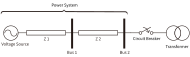
Impedance 1 (Z₁)
Positive-Sequence Reactance 1 (%X₁p)
Enter the positive-sequence reactance of impedance Z1 between the power system and the transformer, expressed as a percentage of the system base impedance.
% Positive-Sequence Resistance 1 (%R₁p)
Enter the positive-sequence resistance of impedance Z1 between the power system and the transformer, expressed as a percentage of the system base impedance.
%
Impedance 2 (Z₂)
Positive-Sequence Reactance 2 (%X₂p)
Enter the positive-sequence reactance of impedance Z2 between the power system and the transformer, expressed as a percentage of the system base impedance.

Enter 0 if not considered.
% Positive-Sequence Resistance 2 (%R₂p)
Enter the positive-sequence resistance of impedance Z2 between the power system and the transformer, expressed as a percentage of the system base impedance.

Enter 0 if not considered.
%
Transformer
Basic Information
Rated Power (S_trans)
Enter the rated capacity of the transformer.
Winding Connection (wtype)
Select the transformer winding connection. Y denotes a star connection and Δ denotes a delta connection. For example, Y-Δ means the primary winding is star-connected and the secondary winding is delta-connected.
Rated Voltage – Primary (V_trans1)
Enter the rated voltage of the primary winding. In the calculation, the voltage is applied to the primary winding.
kV Rated Voltage – Secondary (V_trans2)
Enter the rated voltage of the secondary winding.
kV
Short-Circuit Impedance (Leakage Reactance and Winding Resistance)
Reactance Between Primary and Secondary (%X₁₂)
Enter the percentage reactance between the primary and secondary windings on the transformer’s own base. This represents the leakage reactance based on the transformer rated power and rated voltages. For a two-winding transformer, this value is equally split between the primary and secondary sides.
%
Winding Resistance Input Mode
Select how to enter winding resistance: either the short-circuit test result (combined resistance of both windings) or individual winding resistances.
Primary Winding Resistance (R₁)
Enter the winding resistance of the primary winding.
Ω Secondary Winding Resistance (R₂)
Enter the winding resistance of the secondary winding.
Ω
Magnetizing Inductance
Saturation-approximated flux (Φs)
In the magnetizing inductance saturation characteristic (current–flux curve), enter the flux at the intersection of the fully saturated linear region and the vertical axis, either as a per-unit value (rated flux = 1.0) or as an absolute flux value.
Saturation inductance (Ls)
In the magnetizing inductance saturation characteristic (current–flux curve), enter the slope of the fully saturated linear region, either as a percentage of the base impedance (based on rated power and energized-side rated voltage) or as an inductance value referred to the primary winding.
Analysis Conditions
Circuit Breaker
Energization Phase Angle
Enter the system voltage phase angle at the moment the transformer primary winding is energized (circuit breaker closing), referenced to the a-phase-to-ground voltage sine wave.
deg
Residual Flux
When the transformer has a Δ connection or uses a three-phase three-leg core, the sum of residual fluxes in all phases is generally zero. Clear this checkbox to calculate cases where the sum is not zero.
Phase A Residual Flux (Φra)
Enter the transformer residual flux as a per-unit value (rated flux = 1.0).
p.u. Phase B Residual Flux (Φrb)
Enter the transformer residual flux as a per-unit value (rated flux = 1.0).
p.u.
Phase C Residual Flux (Φrc)
Enter the transformer residual flux as a per-unit value (rated flux = 1.0).
p.u.
Others
Simulation Time (Tmax)
Enter the simulation time.
ms
Notes
You may enter any text in this field. This input does not affect the calculation results and is saved in the traj file.